Key Takeaways
- Healthy coping strategies improve emotional resilience and reduce everyday stress.
- Coping skills support recovery from addiction, anxiety, depression, and trauma alike.
- Effective techniques span mindfulness, exercise, healthy routines, social support, problem-solving, and professional therapy.
- Consistent practice works better than waiting until a crisis hits.
- Professional treatment can help build coping strategies tailored to your specific situation.
Mental health affects how you think, feel, and respond to everyday life. Learning healthy coping strategies can help you manage stress, steady your emotions, strengthen relationships, and support long-term recovery, whether you’re dealing with anxiety, depression, trauma, substance use, or the ordinary weight of daily life.
At Orlando Treatment Solutions, we believe practical coping tools are something anyone can build, with the right support.
Why Coping Strategies Matter
Life brings on unexpected challenges: work pressure, relationship strain, financial stress, health conditions, grief, and trauma. Without healthy ways to handle them, it’s common to fall back on avoidance, isolation, alcohol, drugs, emotional eating, or other behaviors that feel like relief in the moment but cost more later.
Building real coping strategies helps you respond to hard situations deliberately instead of reacting on autopilot. Healthy coping doesn’t eliminate stress; it changes how you move through it. Over time, strong coping skills tend to lower stress levels, ease anxiety symptoms, improve emotional regulation, build genuine self-confidence, strengthen relationships, improve sleep, help prevent relapse during addiction recovery, and generally raise overall life satisfaction.
What Are Coping Strategies?
Coping strategies are the healthy actions, thoughts, and behaviors that help you manage emotional distress, stressful events, and mental health challenges, giving your brain and body room to recover from stress while building resilience for next time.
Some coping strategies address the problem directly; others focus on regulating the emotional response until the situation itself becomes more manageable.
The best ones tend to share a few traits: they’re genuinely healthy, practical, sustainable, personalized to the individual, and easy to practice regularly rather than requiring special conditions. Building this kind of toolkit takes time, but small, consistent steps add up to real change.
What Are the 5 Main Types of Coping Skills?
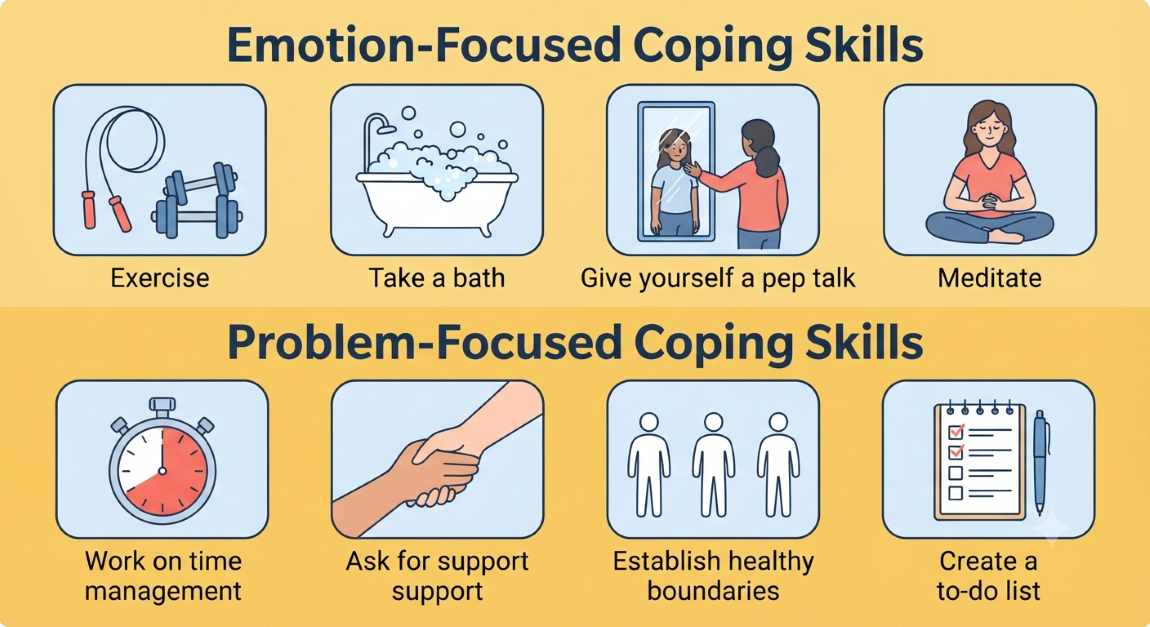
The foundational model here comes from psychologists Richard Lazarus and Susan Folkman, who identified problem-focused and emotion-focused coping as the two primary adaptive styles back in 1984 . Later research and clinical practice expanded on that base, and mental health professionals commonly group coping skills into five practical categories.
Problem-Focused Coping
These skills target the actual source of stress rather than just the feeling it produces: creating a concrete plan, managing finances directly, improving communication with the people involved, seeking professional advice, or setting realistic, achievable goals.
Emotion-Focused Coping
These techniques reduce emotional distress while a situation is still working itself out: deep breathing, journaling, meditation, talking things through with someone you trust, or deliberately practicing gratitude.
Meaning-Focused Coping
Finding purpose within a hard experience helps people stay hopeful even when the situation itself can’t be fixed quickly. This can look like volunteering, spiritual practice, positive reframing, helping others, or working toward forgiveness.
Social Coping
Support from other people is one of the strongest protective factors for mental health that exists. This includes family support, support groups, therapy, peer recovery meetings, and staying involved in a community.
Healthy Lifestyle Coping
Daily habits shape emotional well-being more than most people give them credit for: regular exercise, nutritious meals, real sleep, staying hydrated, and limiting alcohol and drug use.
What Are 5 Strategies to Improve Mental Health?
If you’re not sure where to start, these five foundational habits are a reasonable place to begin.
Practice mindfulness: Mindfulness keeps your attention on the present instead of spiraling into future worry or past regret. Five minutes of deep breathing, a guided meditation, a body scan, or a slow, deliberate walk all count.
Stay physically active: Exercise releases chemicals that genuinely improve mood and reduce stress, and it doesn’t need to be intense to help: walking, swimming, stretching, and cycling all count. Aim for around 30 minutes most days.
Build strong social connections: Isolation tends to make mental health symptoms worse, not better. Reach out to family, friends, recovery groups, faith communities, or mental health professionals; real relationships encourage precisely when it’s hardest to ask for it.
Create healthy daily routines: Predictability reduces stress on its own. A consistent sleep schedule, regular meals, built-in exercise, relaxation time, and time outdoors all contribute to steadier emotional footing.
Seek professional support: Sometimes stress genuinely outpaces what self-management can handle. Therapists, counselors, psychiatrists, and addiction specialists can build coping techniques matched to your specific situation rather than a generic list.
100% Confidential Support is Available 24/7
No matter what you’re going through, you’re not alone. Our dedicated team is here to provide a safe, judgment-free space where you can talk openly and honestly. Whether you need emotional support, resources, or just someone to listen.
We’re here for you—completely confidential and always respectful of your privacy. Call us today!
Effective Coping Strategies to Enhance Your Mental Health
Beyond the foundational habits above, a few specific techniques are worth practicing on their own.
Practice deep breathing: This calms your nervous system within minutes. Try inhaling for four seconds, holding for four seconds, exhaling for six seconds, and repeating for about five minutes.
Journal your thoughts: Writing helps organize emotions and spot patterns you might otherwise miss. Try recording daily wins, challenges, moments of gratitude, mood changes, or personal goals, whatever gives you a clearer read on your own patterns.
Limit negative self-talk: Notice the critical voice when it shows up. Swapping “I always fail” for something closer to “I’m learning and improving” isn’t just positive thinking; self-compassion measurably supports healthier emotional recovery.
Spend time outdoors: Time in nature lowers stress hormones and lifts mood, and even 20 minutes can make a real difference.
Practice gratitude: Writing down three genuinely positive things each day trains your attention to notice the good alongside the difficult, rather than only registering what’s going wrong.
Reduce screen time: A constant stream of news and social media tends to raise stress and anxiety. Setting real digital boundaries, not just intentions, helps.
Learn to say no: Protecting your time is protecting your mental health directly. Healthy boundaries reduce burnout and emotional exhaustion more than most people expect.
Develop relaxation rituals: Reading, music, yoga, stretching, a warm bath, prayer, or meditation, whatever genuinely helps you downshift, is worth turning into a habit rather than an occasional treat.
Focus on good nutrition: Food affects mood more directly than most people realize. Leaning toward fruits, vegetables, lean protein, whole grains, and healthy fats, while limiting excess sugar and processed food, supports emotional stability alongside physical health.
Celebrate little progress: Recovery and mental health both improve one step at a time. Actually recognizing progress, rather than only noticing what’s left to do, builds the motivation to keep going.
Struggling to regain balance? Contact Orlando Treatment Solutions for confidential help.
When Coping Skills Aren’t Enough
Sometimes, despite real effort, symptoms don’t ease up. It’s worth seeking professional help if you’re experiencing persistent sadness, panic attacks, severe anxiety, thoughts of self-harm, real difficulty functioning at work or school, rising substance use, or growing isolation from the people close to you. Professional treatment combines therapy, education, medication when appropriate, and coping strategies built specifically around your situation to help restore emotional stability.
How Mental Health and Addiction Are Connected
Mental health and substance use disorders frequently occur together. Many people start using alcohol or drugs specifically to escape emotional pain, and while substances can provide short-term relief, they tend to worsen anxiety, depression, trauma symptoms, and stress over time rather than resolve them. Building real coping strategies gives people a healthier alternative that actually supports long-term recovery instead of just delaying the underlying problem.
Therapies commonly used to address both together include cognitive behavioral therapy (CBT), dialectical behavior therapy (DBT), trauma-informed therapy, group therapy, individual counseling, family therapy, and mindfulness-based approaches, each aimed at replacing unhealthy coping patterns with ones that hold up over time.
What are 10 Ways to Improve Your Mental Health?
As a quick reference, here’s a condensed version of what’s covered above: exercise regularly, get enough sleep, eat nutritious food, stay connected with the people who matter to you, practice mindfulness, spend time outdoors, set realistic goals, limit alcohol and drug use, practice gratitude, and seek professional help when you need it. None of these is complicated on its own; the difference tends to come from doing them consistently rather than occasionally.

How Orlando Treatment Solutions Can Help
At Orlando Treatment Solutions, every mental health journey gets treated as its own. Treatment plans are built to help clients develop practical coping skills while also addressing the root causes behind emotional distress and substance use, rather than managing symptoms in isolation.
Services include mental health counseling, individual and group therapy, dual diagnosis treatment, addiction treatment, relapse prevention planning, family support, and aftercare planning, all aimed at building coping skills that hold up well past the treatment itself.
Start Building a Healthier Future Today
You don’t have to face stress, anxiety, depression, or addiction alone. If your current coping methods aren’t working anymore, professional support can genuinely change the trajectory.
Contact Orlando Treatment Solutions today at (321) 415-3213 to speak confidentially with a treatment specialist and build a coping and recovery plan designed around your specific situation.
Disclaimer
This article is for educational purposes only and should not replace professional medical advice, diagnosis, or treatment. If you are experiencing severe emotional distress, worsening mental health symptoms, or thoughts of harming yourself or others, seek immediate assistance from a qualified healthcare provider or emergency services. Always consult a licensed mental health professional regarding your specific situation.
References
- National Alliance on Mental Illness (NAMI). Self-Help Techniques for Coping with Mental Illness. https://www.nami.org/Blogs/NAMI-Blog/January-2019/Self-Help-Techniques-for-Coping-with-Mental-Illness
- Centers for Disease Control and Prevention (CDC). Mental Health Resources. https://www.cdc.gov/mentalhealth/
- National Institute of Mental Health (NIMH). Caring for Your Mental Health. https://www.nimh.nih.gov/health/topics/caring-for-your-mental-health
Frequently Asked Questions
What are coping strategies?
Coping strategies are healthy techniques that help people manage stress, difficult emotions, and challenging situations. They include emotional, physical, social, and problem-solving skills that improve resilience and support better mental health over time.
What are the 4 types of coping strategies?
The four common types are problem-focused coping, emotion-focused coping, meaning-focused coping, and social coping. Each serves a different purpose, helping individuals solve problems, regulate emotions, find purpose, or receive support from others.
What are the 5 types of coping strategies with examples?
Five major types include problem-solving (creating action plans), emotional coping (deep breathing), social coping (talking with friends), meaning-focused coping (gratitude), and healthy lifestyle coping (exercise, nutrition, and quality sleep).
What are the 14 coping strategies?
Examples include deep breathing, mindfulness, journaling, exercise, healthy eating, adequate sleep, positive self-talk, gratitude, relaxation, social support, therapy, goal setting, time management, and spending time outdoors. Combining several strategies often provides the greatest mental health benefits.
What are the 12 steps to positive mental health?
Positive mental health includes healthy sleep, balanced nutrition, regular exercise, meaningful relationships, emotional awareness, stress management, gratitude, self-care, purpose, lifelong learning, professional support when needed, and maintaining hope through life’s challenges.