
Rehabilitation is a programmed procedure aimed at assisting persons with substance-related or behavioral problems to develop skills, routines, as well as improve coping mechanisms. Instead of being an isolated incident or result, rehabilitation implies being drawn into systematic support interventions that assist people to overcome changes, deal with stressors, and acquire new behavioral responses. Rehabilitation programs are normally designed through the contribution of trained professionals and are designed to coordinate services in accordance to individual objectives and ease.
Rehabilitation may occur in different shapes and locations where intensity, time, and modes of engagement may vary. Other programs require the participants to stay in a specialized center, whereas others enable the participants to stay at home and visit respective services on a regular basis.
Rehabilitation is aimed at offering a supportive framework, coordinated planning, and sustained reflection that aids the individuals to incorporate the new knowledge and skills in their lives. This paper provides the understanding of the meaning of rehabilitation, the purpose of rehabilitation, the organization of the program, and the considerations made during the selection of a rehabilitation program.
Expert Advice: Rehabilitation combines structured engagement with skills development and coordinated planning for long-term stability.
Defining Rehabilitation
Rehabilitation refers to the planned participation in organized support services designed to help individuals develop skills, routines, and strategies that foster greater stability and healthy functioning. Unlike short episodes of stabilization, rehabilitation programs emphasize continuity of engagement, education, and personal insight.
The term “rehabilitation” may be used in multiple domains, but in the context of substance-related support, it involves consistent participation in structured sessions that address behavior, triggers, coping strategies, and long-term planning. Programs vary in format, intensity, and duration, but share an emphasis on coordinated support rather than isolated interventions.
Rehabilitation supports individuals in building routines that complement daily responsibilities and personal goals.
Core Goals of Rehabilitation Services
Rehabilitation services focus on promoting healthier patterns of behavior, supporting coping strategies, and guiding individuals through gradual changes in routines. Rather than promising specific outcomes, rehabilitation programs emphasize informed decision-making and sustained engagement.
The core goals of rehabilitation may include:
- Developing practical coping strategies for stressors and triggers
- Building self-monitoring skills and awareness
- Establishing routines that support daily life
- Enhancing emotional regulation and problem-solving
- Supporting continuity of care after program participation
These goals help individuals build foundations that support long-term participation in structured routines and lifestyle adjustments.
Daily Structure in Rehabilitation Programs
Rehabilitation programs often provide daily schedules that help individuals engage consistently with support activities, reflection, and skill building. While schedules vary by program type and intensity, a daily structure typically includes planned sessions that balance education, reflective discussions, wellness activities, and personal planning.
Example Daily Structure in a Rehabilitation Program
Time of Day | Activity Type | Purpose |
Morning | Group discussion or workshop | Skill building and shared learning |
Midday | Individual planning sessions | Personal goal review |
Afternoon | Wellness activity | Stress management or physical well-being |
Evening | Peer support or reflection | Reinforcement and community building |
A structured daily routine helps participants remain focused, allocate time effectively, and reduce uncertainty about expectations. Programs provide a framework that participants can adapt to their own long-term routines.
Common Components of Rehabilitation
Rehabilitation programs include multiple integrated components that support consistency, personal insight, and practical skill development.
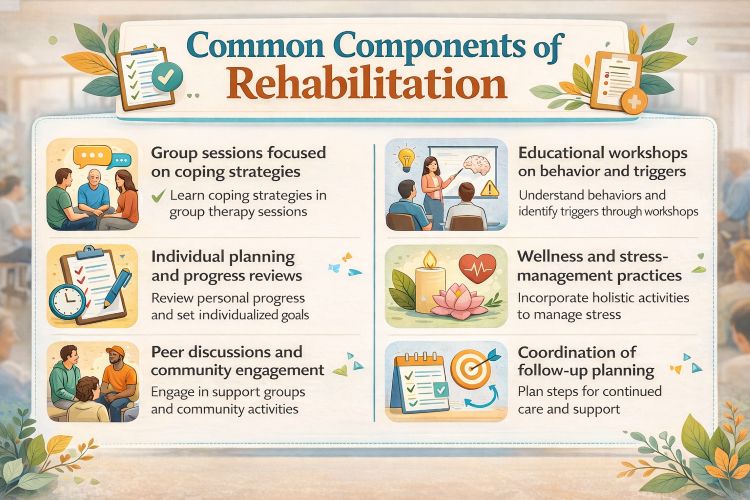
Common components may include:
- Group sessions focused on coping strategies
- Educational workshops on behavior and triggers
- Individual planning and progress reviews
- Wellness and stress-management practices
- Peer discussions and community engagement
- Coordination of follow-up planning
These components work together to support holistic engagement rather than isolated moments of support. Programs may tailor combinations based on individual needs and progress.
FACT: Rehabilitation is a structured support approach aimed at building skills, routines, and coping strategies
Different Levels of Rehabilitation Support
Rehabilitation services are offered in different formats based on intensity, supervision needs, and personal circumstances. Understanding these levels helps individuals choose options that align with their support needs.
Support Level | Living Arrangement | Structure Intensity |
Live onsite full-time | High | |
At home with frequent sessions | Moderate to high | |
At home with weekly sessions | Moderate |
Each level offers structured services but differs in how intensive engagement is and where it takes place. Residential rehabilitation provides concentrated support within a dedicated environment, while outpatient formats allow participants to remain in their daily routines.
Factors Influencing Rehabilitation Experience
The experience of rehabilitation varies based on multiple factors. These variables influence how individuals engage with programming, how schedules align with daily life, and how skills are internalized.
Important influencing factors include:
- Frequency and structure of scheduled sessions
- Personal responsibilities outside of sessions
- Support systems such as family or peer groups
- Readiness to engage with structured planning
- Prior experience with related support services
Individuals who align these factors with program expectations tend to navigate transitions more smoothly.
For help choosing a rehabilitation program, contact Orlando Treatment Solutions
Evaluating how programs integrate personalized planning, flexibility, and continuity of care helps individuals make informed decisions.
How to Choose a Rehabilitation Program
Choosing a rehabilitation program involves assessing how well the environment, schedule, and support components align with personal goals and needs. Important questions to ask include:
- What is the daily or weekly schedule?
- Who facilitates the sessions?
- How is progress monitored?
- What planning is available for after participation?
- How does the program coordinate with external support networks?
Clear answers to these questions help set realistic expectations and support informed participation rather than assumptions about outcomes.
Programs that provide transparent information about expectations, oversight, and planning processes promote thoughtful decision-making.
What to Expect During Rehabilitation
During rehabilitation, participants engage in planned activities designed to build skills, explore coping strategies, and reflect on personal patterns. Days may include group discussions, individual planning sessions, wellness activities, and scheduled evaluations.
Participants may also build connections with peers, share experiences, and learn from others facing similar challenges. These interactions can support both engagement and personal reflection. Attendance, participation, and consistent engagement in scheduled components are central to the rehabilitation experience.
Social and Emotional Aspects of Rehabilitation
Rehabilitation programs often involve interaction with peers engaged in similar support journeys. Group sessions and discussions can provide opportunities for emotional support, shared learning, and collective problem-solving.
Emotional support is not guaranteed, but structured environments often facilitate shared experiences that help individuals explore patterns, reactions, and coping approaches. These discussions encourage reflection and informed adjustments to personal routines.
Planning for Continuity After Rehabilitation
Participation in rehabilitation is often one phase in a larger continuum of structured support. Planning for continuity helps individuals integrate skills and practices learned during rehabilitation into daily life.
Continuity planning may involve:
- Scheduling follow-up support sessions
- Engaging in peer support groups
- Developing personal routines that align with goals
- Connecting with community-based resources
Thoughtful transition planning reduces uncertainty and helps maintain engagement over time.
Learn about continuity planning with Orlando Treatment Solutions
Orlando Treatment Solutions provides structured rehabilitation services designed to support individuals through coordinated planning, education, group engagement, and continuity support. Programs emphasize informed participation, professional oversight, and practical skill building in supportive environments.
Medical Disclaimer: This blog is for informational purposes only and is not a substitute for professional medical advice.
Key Takeaways
- Rehabilitation is a structured support process that develops skills and routines
- Programs vary in intensity and setting
- Daily structure supports consistent engagement
- Choice of program depends on personal needs and schedules
- Continuity planning helps sustain gains beyond participation
FAQs
What is rehabilitation in substance-related support?
Rehabilitation refers to structured recovery programs that focus on building skills, routines, and coping strategies after initial stabilization. These programs support informed participation, consistency, and long-term planning by helping individuals apply learned tools to daily life while strengthening decision-making, accountability, and sustainable recovery-focused habits over time.
What are the common components of rehabilitation?
Common rehabilitation components include group discussions, educational workshops, individual goal planning, stress-management practices, and wellness activities. Together, these elements promote structured engagement, routine development, and skill-building. Programs are designed to support learning, self-awareness, and consistent participation rather than addressing immediate stabilization needs alone.
How do residential and outpatient rehabilitation differ?
Residential rehabilitation involves living onsite within a structured environment for the program’s duration, offering daily schedules and immersive engagement. Outpatient rehabilitation allows individuals to live at home while attending scheduled sessions. The primary difference lies in intensity, environment, and level of daily structure provided.
How long does rehabilitation take?
Rehabilitation length varies depending on program format, individual goals, and engagement level. Some programs last weeks, while others extend for months. Duration is guided by structured assessment, progress reviews, and planning needs rather than fixed timelines or standardized completion requirements across participants.
Why is planning for continuity after rehabilitation important?
Continuity planning helps individuals maintain routines, skills, and strategies developed during rehabilitation as they transition into daily environments. Ongoing structure and follow-up support reduce disruption, reinforce accountability, and encourage consistent application of learned approaches, supporting sustained engagement and long-term recovery-focused stability.
References
- https://americanaddictioncenters.org/rehab-guide/residential/whats-day-like-rehab
- National Institute on Drug Abuse
- Substance Abuse and Mental Health Services Administration
- Centers for Disease Control and Prevention
- National Institute of Health
- PubMed