You might have noticed how one negative thought can lead to a terrible day. You think, “I’m going to mess this up,” and you get anxious. Anxiousness makes it difficult for you to concentrate.
You’re not able to concentrate, so you actually can’t focus. That vicious circle can be broken by cognitive-behavioral therapy (CBT). It’s a simple but powerful principle that can make a difference in your approach to your mental health and recovery.
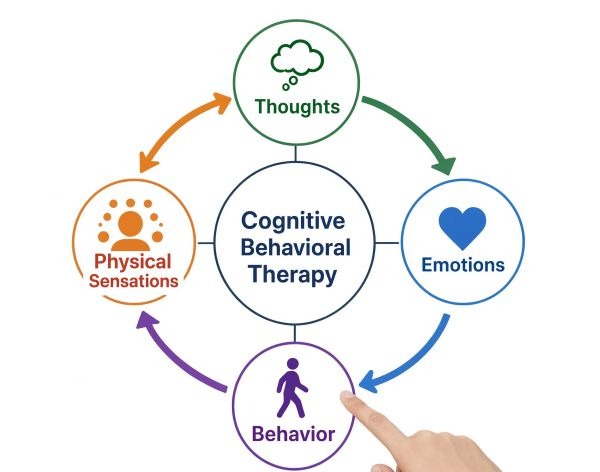
The core principle of CBT is that your thoughts, feelings, and actions are all connected. They exert influence on each other. Emotions are determined by your thoughts. How you feel affects what you do. What you do circles back to reinforce your thoughts.
Luckily, the great news is that if you just alter part of this cycle, then you can improve it all. It is through identifying and challenging these unhelpful thoughts that your emotions and behavior can change in a long-lasting way.
The Core Principle of Cognitive-Behavioral Therapy
The basic concept of CBT is the cognitive model; this model demonstrates that thoughts, feelings and behaviors are all interconnected.
Compare with a triangle. Each point connects to the other two. When something occurs in life, a thought arises. The thought generates an emotion. This feeling results in action. Then that act establishes that initial thought. This is the key to the CBT working.
Let’s use a real-life example. Let’s say you are going to do a presentation at the office. The trigger is the presentation. Your first thought is, “I’m going to get this wrong. I am going to be considered incompetent by everybody.” This thought instills fear and anxiety in the body.
You get anxious and steer clear of eye contact; you talk too fast and you stumble over words. It’s actually worse due to your anxiety. Now your initial idea seems to be correct: “I did mess up. I am incompetent.” The pattern intensifies.
This is where CBT is helpful. Eventually, a person can notice this first negative thought, and then begin to question it and stop the whole process. Don’t say, “I don’t want to mess this up,” but rather, “I will be nervous, but I will do my best.” That realistic thinking leads to an uneasy feeling, but not fear, as it can be controlled. Make eye contact, use an average speech rate, and give a good presentation. Your mind develops and engages more positive thoughts and beliefs.
“The core of CBT lies in the understanding that thoughts, feelings, and actions are all connected. Changing how you think can make positive, lasting changes in how you feel.” – Psych Central
How the Cognitive Model Works
The cognitive model was created by psychiatrist Aaron Beck in the 1960s and is the foundation of cognitive-behavioral therapy.
The model at its basic level demonstrates that it is not an event that makes you feel and act in a certain way, but rather your thoughts about the event. Situations can be similar for two individuals and they can respond differently based on how they think.
In his research, Beck found that people suffering from depression, anxiety, PTSD and other mental disorders have a pattern of negative or distorted thoughts. Its not on purpose. They’re automatic.
Your brain formed these thought patterns for a reason, most likely based on an experience. However, this doesn’t mean that you need to keep them simply because they’ve been built automatically.
CBT consists of two main steps: first, making people aware of these thoughts and then scrutinizing them and suggesting alternative, realistic and balanced thoughts. This is not positive thinking or self-deception. It is about right and fair thinking in relation to situations.
100% Confidential Support is Available 24/7
No matter what you’re going through, you’re not alone. Our dedicated team is here to provide a safe, judgment-free space where you can talk openly and honestly. Whether you need emotional support, resources, or just someone to listen.
We’re here for you—completely confidential and always respectful of your privacy. Call us today!
Three Levels of Thinking in CBT
It is necessary to understand the workings of thoughts in order to have an understanding of the effectiveness of CBT. Actually, there are 3 types of thinking that CBT addresses.
Automatic Thoughts: These thoughts automatically come when a situation occurs. They occur so quickly that you don’t even feel them. They sound like facts, but they aren’t. Typical thoughts include: “Everyone is judging me,” “I am sure I will fail,” and “No one likes me”. The automatic thoughts may be negative and distorted, especially when concerned about anxiety or depression or other issues.
Dysfunctional Assumptions: These thoughts are also known as “core beliefs” or “schemas” that are deeper beliefs. These typically are set in childhood, according to experiences and messages you received. In other words, one might have the core belief “I’m not good enough,” which can then lead to automatic thoughts in various situations, like “I’m going to mess this up. Another person might have “The world is dangerous,” and this will mean they are continually worried and anxious.
Core Beliefs: They are at the most fundamental level. These are just your thoughts about yourself, others and how the world works. This is usually the most problematic and it occurs very early in life. However, CBT allows you to take a look at and change these beliefs as well.
During a therapy session, a CBT therapist will first assist you in determining your automatic thoughts. You then explore the assumptions and beliefs that underlie these thoughts. By working at all three levels, you can make lasting changes, not just temporary symptom relief.
Key CBT Techniques That Apply the Principle
With this concept in hand, let’s now look into particular methods used by therapists in working with the concept.
Thought Records: These are one of the most fundamental CBT tools! Under thought records, you record a situation that irritated you, the automatic thoughts you experienced, the feelings you had as a result, and evidence in favour of and in opposition to your thought. Then you come up with a more balanced and realistic thought. This can be repeated and your brain will become more adept at discovering and challenging unhelpful thoughts.
Cognitive Restructuring is the process of examining distorted thoughts and changing them for more accurate thoughts. Your therapist helps you to ask yourself, “Is this thought true or is it not? What are the facts for or against this thought? What would you say to your friend in this scenario? You learn how to challenge your thoughts in a systematic way and convert them to healthier thoughts.
Behavioral Activation recognizes what depression does to you; withdraw and avoid activities. However, this may tend to amplify depression because one is not experiencing positive experiences or achievement. Behavioral activation involves purposefully engaging in activity in which you don’t wish to be engaged. While performing these activities, your attitude is improved, allowing it to think clearly.
Exposure Therapy is particularly helpful in the treatment of anxiety and PTSD. Under exposure therapy, one takes action to face steps that you have been avoiding. Your brain begins to learn that it’s not dangerous to face it again as they stand in front of you time after time, in the presence of your therapist. With the renewal of the thought, “This will be terrible” turns into “I can handle this.
Problem-Solving is a CBT skill that involves defining a problem, brainstorming a variety of solutions, evaluating and selecting a solution for the problem, trying out the solution, and evaluating the solution. This practical problem solving gives you confidence and you might improve the situation, not just how you think about it, but your life situation.
“CBT works because it’s based on awareness, practice, and action helping you build a healthier mind and a more balanced life.” – Southern Live Oak Wellness
CBT Core Principles Beyond the Main One
CBT is based on a few additional important principles that help make it so effective, with the thought-feeling-behavior connection being the primary one.
Collaboration is essential. In CBT, you are not a passive patient. You’re in charge; you and your therapist are a team. You give information on your life and ideas. Your therapist provides you with a way of understanding and knowledge on how to handle these issues. CBT is a collaboration!
What sets CBT apart from other therapies are its two factors: structure and focus. Each session has a schedule of what is to be done an agenda. The therapist maintains a focus on your problems and objectives. This is a framework that will help you make more progress quicker. Venting is vital but not all that goes on at session. It is a problem-solving and skills development process!
The essential goal of Time-Limited and Goal-Oriented CBT is that it is a relatively short-term therapy. While some treatments may last for a long time, and the focus is on a certain goal or set of goals, CBT typically involves a fixed number of sessions. This can help to ensure treatment is efficient and ensures motivation to work.
Present-Focused CBT focuses on the present and not the past. While your history is important and how you got to thinking this way, the emphasis is on what is occurring in the present and how to move away from this.
Educative CBT teaches you the skills that can be used throughout your life. Your therapist isn’t simply looking to advise you on how to remedy your present issue. They’re training you to be your very own therapist! The skills are taught and can be applied to new problems as they come up.
Homework is a regular part of the CBT. A considerable amount of work is done in between sessions. You may fill out thought records, practice new behaviors or take in educational information. Skills are taught as part of therapy. Homework is your opportunity to practice!
CBT vs. Other Therapy Approaches
To appreciate the principle behind and approach of CBT, it is helpful to understand the differences between CBT and other therapies.
Feature | CBT | Psychodynamic | Humanistic | Acceptance-Based |
Main Focus | Changing thoughts and behaviors | Unconscious conflicts and childhood | Personal growth and self-actualization | Accepting thoughts while changing behaviors |
Time Orientation | Present-focused | Past-focused | Present/growth-focused | Present-focused |
Therapist Role | Active guide and teacher | Neutral explorer | Supportive facilitator | Accepting guide |
Homework Assignments | Regular and essential | Minimal | Minimal | Regular practice |
Duration | Usually short-term (12-20 sessions) | Often long-term (years) | Varies widely | Usually medium-term |
Mechanism of Change | Changing unhelpful thoughts | Gaining unconscious insight | Authentic self-expression | Acceptance and commitment |
Best For | Anxiety, depression, OCD, PTSD, substance abuse | Personality patterns, deep conflicts | Personal growth, self-esteem | Chronic conditions, values-based living |
Scientific Evidence | Extensive research, highly evidence-based | Moderate research | Limited research | Growing research |
Each approach has value. However, CBT’s systematic, present-day oriented approach, is highly effective, with extensive research support for a variety of mental health problems.
How CBT Applies to Addiction and Recovery
CBT can help you make that step toward being free from your addiction because addiction can have the same thought-feeling-behavior patterns that CBT can treat. People can have the automatic thought, “I can’t deal with stress without using.”
Every time that thought causes anxiety. To relieve the anxiety, they use the substance. That use temporarily alleviates anxiety, thus perpetuating the thought “I must use this to cope.”
CBT can help to break this cycle by helping people find much better ways to deal with stress and challenging the idea that they can’t cope without the substance. They learn how to do things. Through thought records, they realize they don’t think as clearly when using. They develop new coping skills.
At Orlando Treatment Solutions, CBT is one of our core treatment approaches. Our therapists are able to work with addiction and co-occurring mental health disorders using CBT principles. CBT is provided as part of our wide variety of addiction treatment, depression treatment, anxiety treatment, and other specialized treatment programs.

Struggling to regain balance? Contact Orlando Treatment Solutions for confidential help.
Getting CBT Treatment in Orlando
Challenge and dismantle those negative thought patterns and transform your life with the support of Orlando Treatment Solutions.
CBT is taught in all our programs and our therapists are CBT-trained. CBT therapy can be utilized for addiction, depression, anxiety, trauma, and more. We offer:
- One-to-one therapy sessions in which you sit with a therapist
- Group therapy in which you learn to use skills with others in recovery
- Intensive Outpatient Programs (IOP) for intensive, yet flexible treatment
- Increased support with Partial Hospitalization Programs (PHP)
- Residential treatment for comprehensive care
- Family Therapy to restore family relationships.
In addition to using CBT in our treatment plans, we also use other evidence-based therapies, like Acceptance and Commitment Therapy and trauma therapy.
If you’re in Orlando or willing to travel, call us at (321) 415-3213 or visit our contact page to learn more. At Orlando Treatment Solutions, our admissions team can help you figure out what level of care is right for you. All conversations are completely confidential, and we’re available 24/7.
References
- Cleveland Clinic, “Cognitive Behavioral Therapy (CBT): What It Is & Techniques”
- Psych Central, “The 3 Basic Principles of Cognitive Behavioral Therapy”
- Grouport Journal, “The Core Principles of Cognitive Behavior Therapy”
- Society for the Advancement of Psychotherapy, “Understanding Core Principles and Techniques of CBT: Part II”
- REACH Behavioral Health, “What Principle Underlies Cognitive-Behavioral Therapy”
- Southern Live Oak Wellness, “What Principle Underlies Cognitive-Behavioral Therapy”
- New York CBT Center, “The 10 Core Principles of Cognitive Behavioral Therapy”
- Focus Journal, “Cognitive Behavior Therapy: Basic Principles and Recent Advances”
- Blueprint, “CBT Thought Records: Therapist Guide to Cognitive Restructuring”
- Headway, “CBT Therapy Techniques to Try: An Overview for Mental Health Providers”
Medical Disclaimer:
This article provides educational information about cognitive-behavioral therapy principles and is not a substitute for professional mental health treatment. If you’re struggling with mental health issues, addiction, or other challenges, please seek evaluation and treatment from a qualified mental health professional. Orlando Treatment Solutions offers comprehensive, evidence-based CBT and other treatments in Orlando, Florida. Contact us at (321) 415-3213 for confidential evaluation and care available 24/7
FAQs
Q: Is the CBT principle that thoughts cause all emotions?
Not exactly. Thoughts significantly influence emotions, but external circumstances also matter. If something genuinely bad happens, feeling sad is appropriate. CBT isn’t about making yourself feel happy no matter what. It’s about having thoughts that are accurate and helpful, so your emotions match reality appropriately.
Q: Can changing my thoughts alone fix my problems?
Changing thoughts is important, but CBT also emphasizes changing behaviors. Sometimes behavioral change comes first and your thoughts follow. For example, if you force yourself to go to a social event even when anxious, you might discover it wasn’t as bad as you thought. Action can change thoughts, not just the other way around.
Q: Is CBT just positive thinking?
No. CBT isn’t about forcing positive thoughts. It’s about realistic, balanced thoughts. If something is actually difficult, saying “This is easy!” isn’t helpful. Saying “This is hard, but I have the skills to handle hard things” is realistic and more helpful.
Q: How long does it take for CBT principles to work?
Some people feel better within weeks. Others need months of consistent work. The research shows that on average, people benefit from about 12 to 20 sessions of CBT, though some need less and some need more. The key is consistent practice.
Q: Can CBT help with trauma?
Yes. In fact, CBT-based therapies like Cognitive Processing Therapy are specifically designed for PTSD and trauma. They help people process traumatic memories and change unhelpful thoughts about the trauma.
Q: Is it possible to apply CBT principles to yourself without a therapist?
To some degree, yes. Many self-help books teach CBT principles. But a therapist is helpful because they can identify thought patterns you might miss and help you apply the principles effectively. For serious mental health issues, working with a professional is recommended.
Q: What if I try CBT and it doesn’t work?
Different people respond to different treatments. If CBT isn’t working, it might mean you need a different approach, a different therapist, or a different level of treatment. It’s worth discussing with your treatment team. It doesn’t mean you can’t recover.
Q: Can children benefit from CBT?
Yes. CBT can be adapted for children and adolescents. The principle is the same, but therapists use age-appropriate language and activities. Kids can definitely learn to recognize and challenge unhelpful thoughts.
Q: Does CBT ignore emotions?
No. CBT absolutely acknowledges emotions. The point is that emotions are often driven by thoughts. By changing thoughts, you can change emotions. But throughout CBT, your feelings are validated and explored.
Q: Is CBT only for mental health issues?
While developed for mental health, CBT principles are used for pain management, sleep issues, relationship problems, work stress, and many other areas. The principle applies to any situation where thoughts influence feelings and behaviors.
Q: What if my automatic thoughts are completely true?
Sometimes they are. If you think, “I didn’t study enough for this exam,” and that’s true, CBT doesn’t try to change that thought. Instead, it might help you think about it differently: “I didn’t study enough, and I’m learning from this. Next time I’ll prepare more.” It’s still accurate, but more helpful.