The knowledge of Polysubstance Abuse and ICD-10 is crucial to both healthcare practitioners and anyone interested in getting clarity on diagnosis and treatment, as well as recovery. The risks are excessive in case of a combination of multiple substances occurring or in a brief time interval; this is why the appropriate diagnosis and systematic treatment are crucially critical.
At Orlando Treatment Solutions, we will help people attain these complexities through individualized and evidence-based therapy programs.
What is Polysubstance Abuse?
Polysubstance abuse refers to the additional use of one drug or substances at a specific time or necessarily related. This can be alcohol, prescribed or illegal drugs. The mixture of substances can increase the harmful activities, and the situation is even more threatening than using individual substances.
With the help of the Orlando Treatment Solutions observations, there exist chances of unanticipated physical and mental impacts in case substances are combined. Indicatively, when opioids are combined with alcohol or benzodiazepines, they slow down breathing and have a greater chance of overdose.
There are various reasons why people can use polysubstance:
- To improve or adjust the actions of another drug.
- To treat withdrawal symptoms.
- When caused by underlying mental health conditions.
What are the ICD-10 Codes for Polysubstance Abuse?
F19.10 – Other psychoactive substance abuse, uncomplicated: Involved risky, or harmful use of a variety of drugs not considered as full dependence (e.g., intermittent misuse resulting in impairment).
F19.20 – Other psychoactive substance dependence, uncomplicated: The code is applied in cases where it is obvious that compulsive use, tolerance or withdrawal symptoms are present.
F19.21 – Other psychoactive substance dependence, in remission: It is used in situations when the patient had an addiction to the substance but quit.
F19.18 – Other psychoactive substance abuse with other psychoactive substance-induced disorders: Refers to the abuse that causes some induced disorders.
How Does ICD-10 Work for Polysubstance Abuse Diagnosis?
ICD-10-CM codes (F10-F19) are mental and behavioral disorders associated with the use of
psychoactive substances and are categorized by the type of substance use, severity (abuse/dependence), and the clinical expression.
These codes enable providers to report particular statuses, such as addiction, intoxication or withdrawal, that are important in terms of planning treatment and billing.
With Polysubstance Abuse and ICD-10, the diagnosis is more subtle. Clinicians consider instead of one code:
The primary substance that is toxic.
- Grooves and intensity of use.
- Co-morbid mental illnesses.
- Cases exist where one might have a couple of ICD-10 codes that can explain the complication of the condition.
Why Does Getting the Right Polysubstance Abuse Diagnosis Matter?
Specific diagnosis of Polysubstance Abuse and ICD-10 can assist in providing the appropriate type of treatment to individuals. It can lead to the absence of proper care or the omission of risks due to such misdiagnosis.
The major benefits of an appropriate diagnosis are:
- Tailored treatment planning
- Better and safer use of medication.
- improved recovery outcomes in the long-term.
- Reduced risk of a relapse.
Since various substances do not impact the brain and body according to the same mechanisms, treatment needs to work on all of the substances at once, not only a single substance.
Common Substances Involved in Polysubstance Abuse
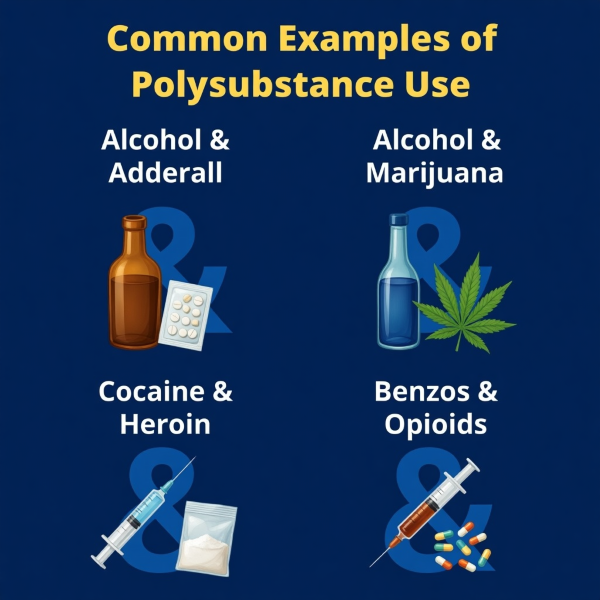
A combination of polysubstance use is often:
- Alcohol and opioids
- Cocaine and alcohol
- Benzodiazepines and opioids
- Stimulants and depressants
Each and every combination presents its danger. To illustrate this, the stimulants when used would be able to overcome the depression caused by the other drug and one would be taking a larger dose than the body would not be able to take.
100% Confidential Support is Available 24/7
No matter what you’re going through, you’re not alone. Our dedicated team is here to provide a safe, judgment-free space where you can talk openly and honestly. Whether you need emotional support, resources, or just someone to listen.
We’re here for you—completely confidential and always respectful of your privacy. Call us today!
Signs of Polysubstance Abuse
The symptoms of polysubstance abuse can be detected in their early stages and prevent the worst. The symptoms can be different, depending on the substances used but frequently involve:
- Irritability or mood swings.
- Lacking sense or being in the wrong way.
- Balance or coordination problems.
- Increased tolerance to multiple drugs.
- Not using withdrawal symptoms
Being aware of these warning signs is important in early intervention and correctly apply the Polysubstance Abuse and ICD-10 guidelines.
How is Polysubstance Abuse Diagnosed?
Polysubstance Abuse and ICD-10 are diagnosed based on an in-depth and systematic evaluation. Overall, providers take into account:
- Medical and psychiatric history.
- Comprehensive drug history.
- Comorbid mental disorders.
- Physical examination findings
Professional interviews and confirmed screening instruments might also be utilized by clinicians to determine both the severity and functional consequences of substance use.
What are the Treatment Options for Polysubstance Abuse?
The Multi-layered personalized approach should be used to treat Polysubstance Abuse and ICD-10. The treatment ought to be multifaceted and ad hoc since it entails several substances.
Medical Detoxification
The first step is frequently a detox. It helps in eliminating substances in the body safely and attractively; it can be applied to treat withdrawal symptoms. They need to be followed up with medical supervision, particularly with a number of substances, due to the high chances of complications.
Behavioral Therapy
Cognitive-behavioral therapy (CBT) and other therapies might help an individual to realize triggers, seek a healthier method of dealing with them, and change undesirable behavioral patterns.
Medication-Assisted Treatment (MAT)
In some cases, drugs can be employed to control cravings or withdrawal symptoms. They are chosen all appropriately depending on the nature of the substances and the medical history of the individual.
Dual Diagnosis Treatment
People with polysubstance abuse have co-occurring mental health disorders, such as anxiety or depression. It is much more effective to treat both of them at the same time.
Long-Term Aftercare
The treatment of the first instance is not the end of the healing. Continuous support (relapse prevention strategy, peer support group, counseling) helps to obtain sobriety and long-term stability.
Why Does Polysubstance Abuse Treatment Need to Be Personalized?
There is not one couple abusing polysubstances. Zhenoglu et al. (2018) state that it is this off-the-shelf treatment that needs to be tailor-made in the case of Polysubstance Abuse and ICD-10.
The treatment plans are created in Orlando Treatment Solutions to:
- Hit on individual habits of use.
- Within the emotional, mental health and physical health requirements.
- Communication and support: Support in all recovery processes.

What Does Long-Term Recovery From Polysubstance Abuse Look Like?
The abuse of polysubstances is a disease that can be overcome by providing a person with the necessary support and treatment. The road can be tedious and hard, yet with a progression of attention, accountability and perseverance, various individuals achieve irreversible sobriety.
Education on Polysubstance Abuse and ICD-10 would help an individual and family make a well-informed choice in terms of the treatment method. It also allows caregivers to offer more specific and beneficial treatment.
Through proper treatment and care, people are able to:
Rebuild meaningful relationships
- Increase physical and mental health.
- Get back their stability and control their lives.
How Do You Get Started With Polysubstance Abuse Treatment?
It is not just you who has Polysubstance Abuse and ICD-10, or a family member who is experiencing the problem. Orlando Treatment Solutions offers evidence-based treatment, which is sensitive, compassionate, and successful to your needs.
Call now (321) 415-3213 and speak to a specialist and begin to live a substance-free and healthier life. The aid is now at hand; you can begin to recuperate today.
Medical disclaimer: This content is for informational and educational purposes only and does not constitute medical advice, diagnosis, or treatment.
Struggling to regain balance? Contact Orlando Treatment Solutions for confidential help.
Frequently Asked Questions (FAQs)
What is the ICD-10 code for polysubstance abuse?
There isn’t a single specific ICD-10 code for polysubstance abuse. Instead, clinicians assign multiple substance-related codes based on the substances used and their effects, ensuring accurate documentation and treatment planning.
What is the difference between F42 8 and F42 9?
F42.8 refers to other specified obsessive-compulsive disorders, while F42.9 indicates unspecified obsessive-compulsive disorder. The difference lies in whether specific symptoms are clearly identified or remain broadly categorized.
How do you code polysubstance abuse?
Polysubstance abuse is coded by identifying each substance involved and assigning appropriate ICD-10 codes. Clinicians prioritize the substance causing the most harm while documenting all relevant substance use patterns.
Is R53-1 a primary diagnosis?
R53.1 represents weakness and is generally not used as a primary diagnosis when a more specific underlying condition is identified. It is typically considered a symptom rather than a standalone diagnosis.
What is the difference between F10 10 and F10 20?
F10.10 refers to alcohol abuse, uncomplicated, while F10.20 indicates alcohol dependence, uncomplicated. Dependence involves physical or psychological reliance, whereas abuse focuses on harmful usage without dependence.
What does diagnosis Z79 899 mean?
Z79.899 indicates long-term use of other medications. It is used to document ongoing medication therapy that may affect treatment decisions, but it does not represent a disease or disorder itself.